
From the farm to your hands: Our honest story behind organic leather

When you buy a leather product, you usually don't know much about where it really comes from. One label says "Made in Germany." Another promises "sustainable" or "organic." But what's really behind it? Which farm? Which tannery? Which hands touched this piece of leather before it reached you?
And more importantly: What story does the brand you buy tell? Is there a conviction behind it, a heritage, a person with a name and a story? Or just a logo? At Yotimo, we can answer these questions. Concretely. With names, places, and real people.
The problem with "Organic-leather"
The term "organic leather" sounds appealing. It conjures up images of green pastures, happy animals, and clean production. But it's not legally protected. This means anyone can use it without much to back it up. Many manufacturers call their leather "organic" because it's vegetable-tanned. That's good, no doubt. But it says nothing about the life of the animal whose hide ultimately becomes a wallet or belt. Most manufacturers simply don't know. We do.
There is already certified organic leather on the market that is significantly better than the conventional standard. The IVN Natural Leather Certificate from the International Association of Natural Textile Industry monitors the entire production chain from tanning to the finished leather, completely prohibits chromium salts and heavy metals, and sets strict environmental and social standards. The Biokreis certificate goes a step further and also considers animal husbandry before slaughter. That's good. That's significantly better than the market average. And it shows: The demand for genuine organic leather is growing.
We go further. Not because the certificates aren't good, but because we know the farm. The farmer's name. The names of his animals. The tannery, which has operated according to the same principles for over 130 years. No certificate can replace this direct connection. There is no middleman between the animal in the pasture and the product in your hands.
Station 1: The URIA farm in Balingen-Ostdorf

Our story begins at the foot of the Swabian Alps, in Balingen-Ostdorf. There lives the URIA farm's cattle herd. Nearly 300 animals, grazing year-round in family groups, without dehorning, without concentrated feed, without ear tags. Behind the URIA farm is Ernst Hermann Maier, a farmer with a clear philosophy: He knows each of his animals by name. Like a family. With heart and soul. "Free and completely without coercion," he says, is how they should live.
And so it is. URIA is more than a farm. It is an association, a movement, a decades-long struggle for a different understanding of animal husbandry. The name comes from the aurochs, the wild wild ancestor of our modern cattle.

A scientific depiction of the aurochs, the extinct wild ancestor of our modern domestic cattle. Its actual appearance is not fully documented and is based on archaeological finds, historical sources, and scientific reconstructions.
It's important to know: No animal dies specifically for its leather. Leather is a byproduct of the meat industry. If it weren't processed into a high-quality product, it would simply be waste. Of course, it would be wonderful if no animal had to die. That's an honest statement, and we stand by it. But as long as people eat meat, there will be hides. That's a reality we won't deny. The question isn't whether, but what happens to them. Utilizing 100% of the hide and giving it a second life isn't just logical for us. It's an obligation. An act of respect for the animal. Because this animal lived. It had a name. It had its place in the herd. And that's precisely what you're supporting when you hold a Yotimo product in your hand.
The Japanese call this principle "mottainai." It means something like "too valuable to waste" and expresses respect and gratitude for everything nature gives us. Resources have value. They deserve to be used to their fullest potential. Nothing should be carelessly thrown away. That's exactly how we feel about leather.
At the end of their lives, the animals are slaughtered with a pasture shot, right where they lived. No animal transport. No slaughterhouse stress. No final walk through unfamiliar halls. In nature, death is part of life. It's not cruelty, it's the cycle of life. The difference lies in how it's done. With pasture shooting, the animal dies in its familiar surroundings, under the open sky, without fear, without even knowing it's happening. That's precisely what's important to us. And that's exactly what URIA does for us. Ernst Hermann Maier fought for decades for this approach, battling authorities and bureaucracy. In 2000, he was one of the first farmers in Germany to win the right to shoot his cattle in the pasture. Today, several hundred farms in Germany practice this. That's the difference between a certificate and a genuine conviction. The hide that results is a byproduct. It would be nothing otherwise. We transform it into something with a story, with awareness, with a purpose. Something that lasts for decades.
More about the URIA farm: www.uria.de | https://www.uria-shop.de/ueber-uns/

Station 2:
August Renz leather factory in Tuttlingen, since 1888

From the Swabian Alb, the hide travels on to Tuttlingen, to the August Renz leather factory. The name Renz was first mentioned in connection with the tanning trade in 1810. August Renz laid the factory's foundation stone, which still stands today, in 1888.

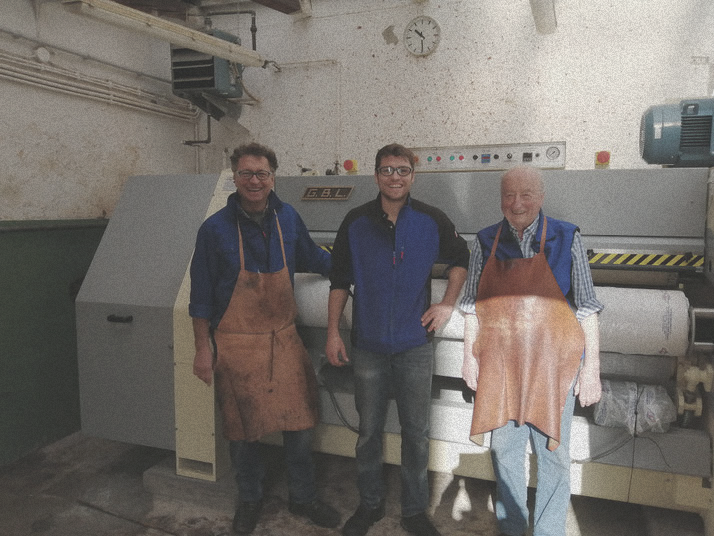
Today, Christoph Renz runs the family business in its fourth generation. With his son Johannes Renz joining the company in 2018, the fifth generation is already on board. Three generations currently work in the business simultaneously. With only 11 employees, the August Renz leather factory is one of the last true craft businesses of its kind in Germany.
More about the leather factory: www.lederfabrik-renz.de


The oldest art in the world: What tanning really means
Tanning is one of the oldest crafts known to humankind. Long before factories, chemicals, or machines existed, people knew how to transform animal hides into a durable, valuable material.

The indigenous peoples of North America, the Plains Indians, have perfected this practice for millennia. A hunted buffalo was used completely: meat for food, bones for tools, and hide for leather used in tipis, clothing, and containers. Nothing was wasted. For them, the act of tanning was not merely a craft; it was an expression of respect for nature. Those who took from it also gave back.
This conviction, that one owes nature a debt of gratitude and respect, was deeply rooted in their culture. Killing an animal and carelessly discarding its hide would have been unthinkable. This ancient knowledge is still embodied in the tanning craft today. Tanning is not simply hide plus water plus a recipe. It is centuries of knowledge about materials, reactions, timing, and temperatures. A craft passed down from generation to generation.
Chrome tanning: What really happens in most factories
Today, around 80 to 85 percent of all leather goods worldwide are tanned using chromium salts. The process was developed in the 19th century and revolutionized the leather industry. It is fast, inexpensive, and produces soft, supple leather in a few hours instead of weeks or months.
The price is enormous. Chrome tanning uses chromium III, which is initially considered harmless under controlled conditions. The problem: Under certain conditions, such as errors in the production process, improper storage, or burning old leather products, chromium III oxidizes to chromium VI. And chromium VI is highly toxic, carcinogenic, and easily penetrates the skin. That alone would be alarming. But the real catastrophe unfolds where no controls are in place.
In Ranipet, India, one of the world's largest tannery districts, the uncontrolled disposal of chromium-containing wastewater and waste has so severely contaminated soil and groundwater that, according to the international Polluted Places Initiative, the health of approximately 3.5 million people is at risk. Rivers shimmer blue-green. Fields are infertile. Children grow up in a poisoned environment. Workers in these tanneries shovel chromium salts without protective equipment. They inhale the fumes. Their hands are constantly immersed in chemical baths. Skin diseases, respiratory illnesses, cancer—these are not isolated incidents.
This is everyday life. And the leather produced under these conditions ends up in cheap shoes, bags, and belts. In German stores. In fast-fashion shops. And nobody asks where it comes from.
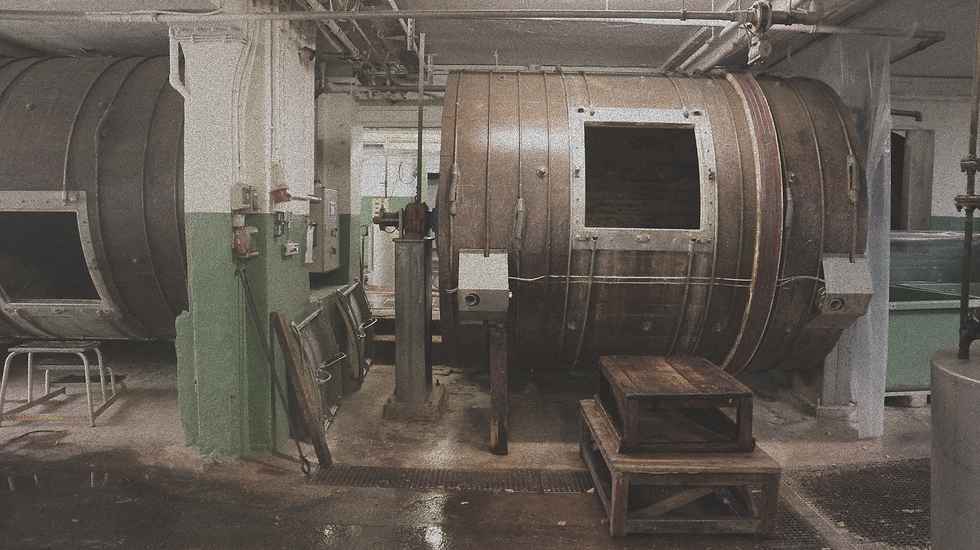
At the August Renz leather factory in Tuttlingen, only vegetable tanning is used. Purely plant-based. With tanning agents from tree bark and plant extracts provided by nature itself. No chromium salts. No heavy metals. No toxic wastewater. The process takes weeks, months, not hours. It requires experience, a delicate touch, and the knowledge of five generations. The result is a leather that lives, breathes, and develops a unique patina over time. A leather that is compostable. That leaves nothing behind that harms nature.
Station 3: Handmade in Urbach, Baden-Württemberg (Germany)

The finished leather arrives at our small workshop in Urbach, Baden-Württemberg. Here, Yotimo products are created, piece by piece, by hand. No assembly line. Every wallet, every belt, every bag is individually cut, folded, sewn, and sanded. This takes longer than industrial production. It costs more. But it means that every piece is made with care and attention.

Why this is important
You're not just buying a wallet or a belt. You're buying a choice. The choice of a supply chain you can understand.
Choosing an animal that had a name and spent its life grazing in a pasture. Choosing a tannery that has operated according to the same principles for over 130 years. Choosing craftsmanship that endures. Fast fashion and mass production have conditioned us not to ask where things come from.
Cheap, fast, gone.
Yotimo is the opposite.
The question you should ask
The next time you hold a leather product in your hand, simply ask: Where does this come from? And if the answer remains vague, you'll know.
what that means.
Short distances, clear accountability. No hiding behind long supply chains. Only real people, real materials, real craftsmanship.
That's all. And that's enough. That's Yotimo.
Why Yotimo?

My name is Oguzhan (pronounced: O-ushan → Osan) , founder and craftsman behind Yotimo.
What hardly anyone knows: Oguzhan is no ordinary name. It goes back to Oguz Khan, the legendary military leader and founding hero of the Turkic peoples, and in Turkish means something like "the heroic, courageous, and strong ruler." A name steeped in history. And, as I've discovered over time, a history that's bigger than I ever imagined.
In 2015, I traveled through America. In Las Vegas, far from the glitz and glamour of casinos, I encountered something I hadn't expected: a small family, descendants of Native Americans. We quickly bonded and spent a long evening laughing, sharing stories, and having deep conversations about nature, respect, and heritage.
They invited me to stay with them. I accepted. It was one of those rare encounters that you don't plan and never forget.
We talked for a long time about hunting and leather. They told me how their ancestors handled animal hides. How they tanned them. How each hide was processed by hand, using natural materials from nature: brains, tree bark, smoke. No laboratory, no chemicals, no assembly line. They told me that what we call tanning today has hardly anything in common with what their ancestors did. Back then, it wasn't a process. It was a ritual. A tribute to the animal that had given its life.
At some point, I told them about my idea to start a leather goods company. That I was looking for a name. One that fit what I wanted to do: honest craftsmanship, natural materials, a deep connection to nature.
I also told him about my ancestors. They come from the region around the Black Sea, an area known for its beekeeping for centuries. Bees, honey, the close connection to nature – that has always been part of my family. Even my family name carries this history within it, as it is derived from the Turkish word for beekeeper.
Raje listened attentively, smiled and said: "Yotimo".

In their language, the word means "nectar-collecting bee." He explained to me that such names were very special in his culture. Names like Yotimo were traditionally given to horses and animals, very rarely to people. For the indigenous people, every animal was sacred. Horses, cattle, every living being was treated with deep respect, as part of nature, belonging to it and giving something back to it.

What still fascinates me to this day is that Yotimo sounds almost Japanese at first glance. And indeed, there is a Japanese name, Yoshitomo, which sounds very similar and, depending on the spelling, means something like virtue and friend or justice and wisdom. The fact that a name from the world of North American Indigenous peoples carries such a sound, one that resonates across continents, is something I still find beautiful.
What touches me even more in retrospect is that this encounter may not have been a coincidence. Science now shows that the ancestors of the Native Americans and the early Turkic peoples, from whom my family also descends, share common roots. Both trace their origins back to the same ancestral homeland: Siberia and the Altai Mountains in Central Asia. Around 20,000 years ago, their paths diverged; one group migrated across the Bering Land Bridge to America, while the other remained in Asia and became the ancestors of the Turkic peoples, and thus my ancestors.

My name is Oguzhan, the heroic ruler of the Oghuz. The name Yotimo, the nectar-gathering bee. Two names. Two peoples. The same roots. Millennia of separation. And then one evening in Las Vegas.
I didn't need a moment to think about it. The nectar-collecting bee is small, but indispensable. It works silently, with precision and dedication. It takes from nature, but also gives back.
That's exactly what I wanted Yotimo to be.
Yotimo connects more than one story. It connects worlds.
Since then, our products have borne this name. And this attitude.